Peter's electronic projects Peter's electronic projects
| Aspect | Urban | Rural | |--------|-------|-------| | | High (graduate + professional) | Low to middle (often secondary only) | | Work | Formal sector (IT, services) | Agriculture, daily wage, self-help groups | | Mobility | Independent (public transport, driving) | Restricted, often needs male escort | | Marriage age | Mid-20s to 30s | Often before 21 (legally 18) | | Tech access | High (smartphone, internet) | Low to medium (feature phones common) | | Health access | Hospitals, clinics, sanitation | Distant PHCs, open defecation persists |
What do you think about Indian women's lifestyle and culture? Share your experiences, observations, or insights in the comments below!
The arranged marriage is evolving. It is no longer "parents choosing a spouse in secret." Today, it is "parents shortlisting via a matrimonial app, followed by a supervised coffee date."
The lifestyle of Indian women today is a vibrant, moving mosaic. In 2026, the narrative has shifted from merely balancing "home and work" to a more profound integration of cultural identity with modern autonomy. From the boardrooms of Bengaluru to the artisan clusters of Odisha, Indian women are redefining what it means to lead a culturally rooted yet progressive life. 1. The Wardrobe Revolution: Functional Tradition
remains central to identity, though many women seamlessly mix these with Western styles like jeans. Symbols like the
The explosion of affordable internet has democratized the Indian woman's lifestyle. From rural artisans selling jewelry on Instagram to "Mom-bloggers" sharing parenting tips on YouTube, digital spaces have become the new community squares.
Indian women play a vital role in festivals and celebrations, which are an integral part of Indian culture. Women often take the lead in organizing and participating in festivals, such as Diwali, Navratri, and Holi.
 Try it now, before building! Click on the transmitter buttons with the
green
labels
on the left and see how the receiver outputs (K1-K8) change. Change
the number of transmitter or receiver channels. Switch the receiver
output type between latched and momentary.
Try it now, before building! Click on the transmitter buttons with the
green
labels
on the left and see how the receiver outputs (K1-K8) change. Change
the number of transmitter or receiver channels. Switch the receiver
output type between latched and momentary.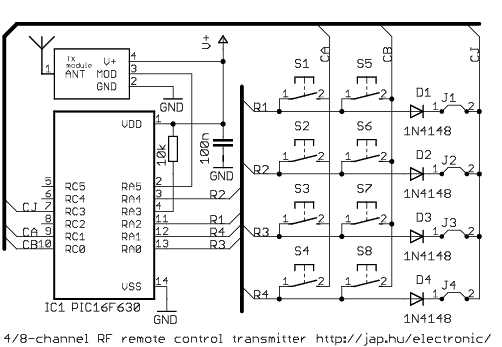
| part | description |
| C1 |
100nF ceramic capacitor |
| R1 |
10k resistor (1/8W) |
| D1-D4 | 1N4148 diode (optional) |
| S1-S8 |
tact switch, DTSM 61N or similar |
| IC1 | PIC16F630 or PIC16F676 microcontroller, pre-programmed |
| TXMOD |
radio
transmitter module, see text (hardware) |
| B1 |
battery between 2-5.5VDC (check TXMOD specs for valid voltage range) |
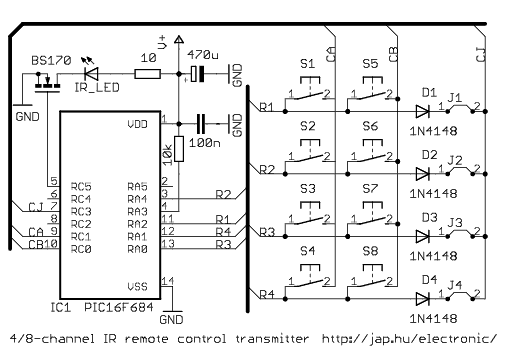
| part | description |
| C1 |
100nF ceramic capacitor |
| C2 |
470 uF 6.3V, electrolytic
capacitor |
| R1 |
10k resistor (1/8W) |
| R2 |
10 ohm resistor (1/4W) |
| D1-D4 | 1N4148 diode (optional) |
| D5 |
IR transmitter LED |
| Q1 |
BSS138 or similar N-MOSFET |
| S1-S8 |
tact switch, DTSM 61N or similar |
| IC1 | PIC16F684 microcontroller, pre-programmed |
| B1 |
battery between 2-5.5VDC (CR2032, 3.6V LiIon battery or 3xAA
batteries) |
| please
observe the corresponding address configuration! |
|
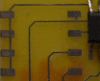 transmitter: no diodes connected |
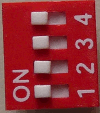 receiver: switches all ON |
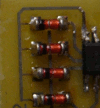 transmitter: all diodes connected |
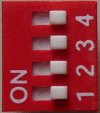 receiver: switches all OFF |
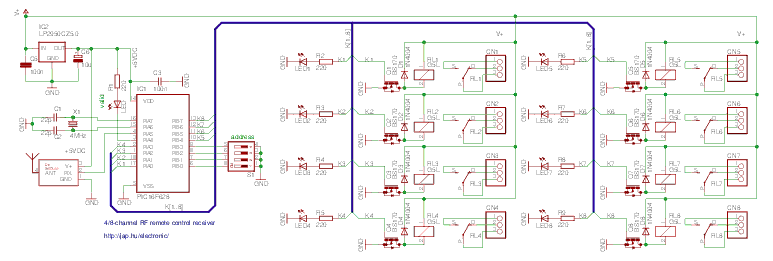
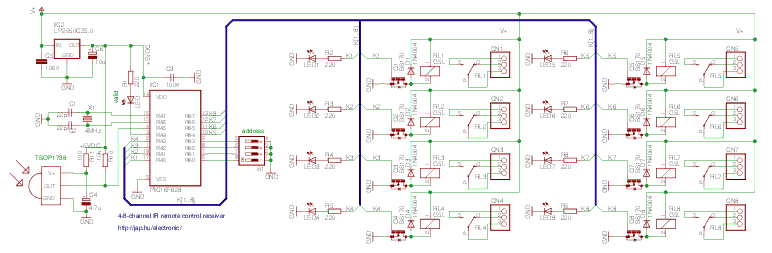
parts list
| part | description |
| C1, C2 | 22pF ceramic capacitor |
| C3, C5 | 100nF ceramic capacitor |
| C6 | 10uF 6.3V electrolytic capacitor |
| CN1-CN8 | PCB terminal block, 3-way (DG301) |
| D1-D8 | 1N4004 diode |
| IC1 | PIC16F627 or PIC16F628 or PIC16F627A or PIC16F628A microcontroller, pre-programmed |
| IC2 | LP2950CZ5.0 voltage regulator |
| LED | 3mm LED (green) |
| LED1-LED8 | 3mm LED (red) |
| Q1-Q8 | BS170 N-channel mosfet transistor |
| R1-R9 | 220R resistor (1/8W) |
| RL1-RL8 | G5LE relay, see text for coil voltage selection |
| S1 | piano DIP switch, 4-way |
| X1 | 4MHz HC49 crystal |
| RXMOD | 3-pin radio receiver module, see text (hardware) |
| please
observe the corresponding address configuration! |
|
| transmitter: no diodes connected |
receiver: switches all ON |
| transmitter: all diodes connected |
receiver: switches all OFF |
| Aspect | Urban | Rural | |--------|-------|-------| | | High (graduate + professional) | Low to middle (often secondary only) | | Work | Formal sector (IT, services) | Agriculture, daily wage, self-help groups | | Mobility | Independent (public transport, driving) | Restricted, often needs male escort | | Marriage age | Mid-20s to 30s | Often before 21 (legally 18) | | Tech access | High (smartphone, internet) | Low to medium (feature phones common) | | Health access | Hospitals, clinics, sanitation | Distant PHCs, open defecation persists |
What do you think about Indian women's lifestyle and culture? Share your experiences, observations, or insights in the comments below!
The arranged marriage is evolving. It is no longer "parents choosing a spouse in secret." Today, it is "parents shortlisting via a matrimonial app, followed by a supervised coffee date."
The lifestyle of Indian women today is a vibrant, moving mosaic. In 2026, the narrative has shifted from merely balancing "home and work" to a more profound integration of cultural identity with modern autonomy. From the boardrooms of Bengaluru to the artisan clusters of Odisha, Indian women are redefining what it means to lead a culturally rooted yet progressive life. 1. The Wardrobe Revolution: Functional Tradition
remains central to identity, though many women seamlessly mix these with Western styles like jeans. Symbols like the
The explosion of affordable internet has democratized the Indian woman's lifestyle. From rural artisans selling jewelry on Instagram to "Mom-bloggers" sharing parenting tips on YouTube, digital spaces have become the new community squares.
Indian women play a vital role in festivals and celebrations, which are an integral part of Indian culture. Women often take the lead in organizing and participating in festivals, such as Diwali, Navratri, and Holi.
LATCH_MASK EQU B'00001111' sets channels 8-5 to momentary
and
channels 4-1 to latched (toggle) mode. Then use the compiler (MPLAB or
gputils) to
assemble the code.clrf
0x91 ;
ANSEL